Creating and Maintaining Healthy Boundaries With Others
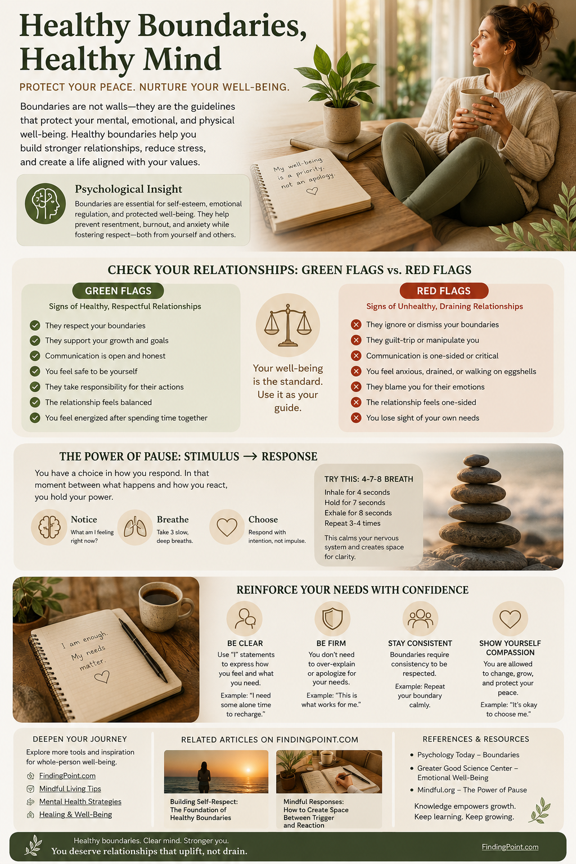
How to recognize green and red flags, pause before reacting, and reinforce your needs without losing your sense of self.
Introduction: Boundaries Are Not Walls—They Are Psychological Guardrails
Healthy boundaries are one of the most important tools for maintaining a clear, steady, and resilient mind. They are not cold walls that shut people out; they are psychological guardrails that help you decide what you will allow into your time, emotional space, body, attention, and inner life. When someone around you is consistently negative, critical, demanding, manipulative, or draining, boundaries become even more essential. Without them, you may absorb other people’s moods, feel responsible for their reactions, or slowly adjust your life around avoiding conflict. Over time, this can wear down confidence, increase anxiety, and leave you feeling disconnected from your own needs.
From a psychological standpoint, boundaries help protect the nervous system from chronic activation. When you are repeatedly exposed to criticism, guilt-tripping, emotional dumping, or unpredictable behavior, your mind may begin scanning for danger even when nothing obvious is happening. You might become hypervigilant, overexplain yourself, or say “yes” to keep the peace. This is not weakness; it is often a learned survival strategy. But a healthy mind requires more than survival. It requires space to think, breathe, choose, recover, and grow.
Why Negative Relationships Affect the Mind So Deeply
Humans are wired for connection. Our brains constantly read facial expressions, tone of voice, body language, consistency, and emotional cues from others. Supportive relationships can help regulate stress, increase a sense of safety, and reinforce self-worth. Negative relationships can do the opposite. When someone regularly dismisses your feelings, criticizes your choices, drains your energy, or makes you feel guilty for having needs, your mind may start adapting around that person’s instability.
Psychologically, this can create a cycle: the other person’s negativity becomes the stimulus, your nervous system reacts, your thoughts try to make meaning of the discomfort, and your behavior shifts toward appeasing, defending, withdrawing, or exploding. When repeated often enough, this cycle can become automatic. You may stop asking, “What do I need?” and start asking, “How do I keep them from being upset?” That shift is costly because it trains the mind to prioritize external approval over internal alignment.
Healthy boundaries interrupt that cycle. They return choice to you. They clarify where your responsibility ends and another person’s begins. They help you notice that you can care about someone without carrying their emotional life for them. You can be compassionate without being available at all times. You can love someone and still say, “This conversation is not healthy for me right now.”
A Green Flag and Red Flag Filter for Relationships
One practical way to protect your mental health is to use a “flag filter.” A filter is not a harsh judgment of another person; it is a reflective tool that helps you notice patterns. A single bad day does not define someone. Everyone can be stressed, reactive, or imperfect. But repeated patterns reveal the emotional climate of a relationship. Ask yourself: after spending time with this person, do I usually feel clearer, calmer, and more like myself—or smaller, tense, guilty, and emotionally depleted?
Green Flag Filter: Signs a Relationship Supports Your Mental Health
· They respect your “no” without punishing you, mocking you, or repeatedly trying to change your mind.
· They can hear feedback without immediately blaming, attacking, or becoming the victim.
· They encourage your growth, independence, friendships, rest, and goals.
· They show consistency between words and actions.
· They take accountability when they cause harm and make genuine efforts to repair.
· They do not require you to shrink, perform, or constantly explain yourself to be accepted.
· You feel emotionally safer, steadier, and more authentic after interacting with them.
Red Flag Filter: Signs a Relationship May Be Draining or Harmful
· They repeatedly dismiss your feelings as “too sensitive,” “dramatic,” or “selfish.”
· They use guilt, shame, anger, silence, or withdrawal to control your choices.
· They expect unlimited access to your time, attention, or emotional energy.
· They criticize your boundaries instead of trying to understand them.
· They make you feel responsible for regulating their mood.
· They only respect your needs when those needs do not inconvenience them.
· You often leave interactions feeling confused, depleted, anxious, resentful, or less like yourself.
When the red flags are occasional, respectful conversation may help. When they are frequent and the person refuses accountability, stronger boundaries may be necessary. In some cases, especially when manipulation, intimidation, coercion, or emotional abuse is present, distance or professional support may be the healthiest option.
The Pause Between Stimulus and Response
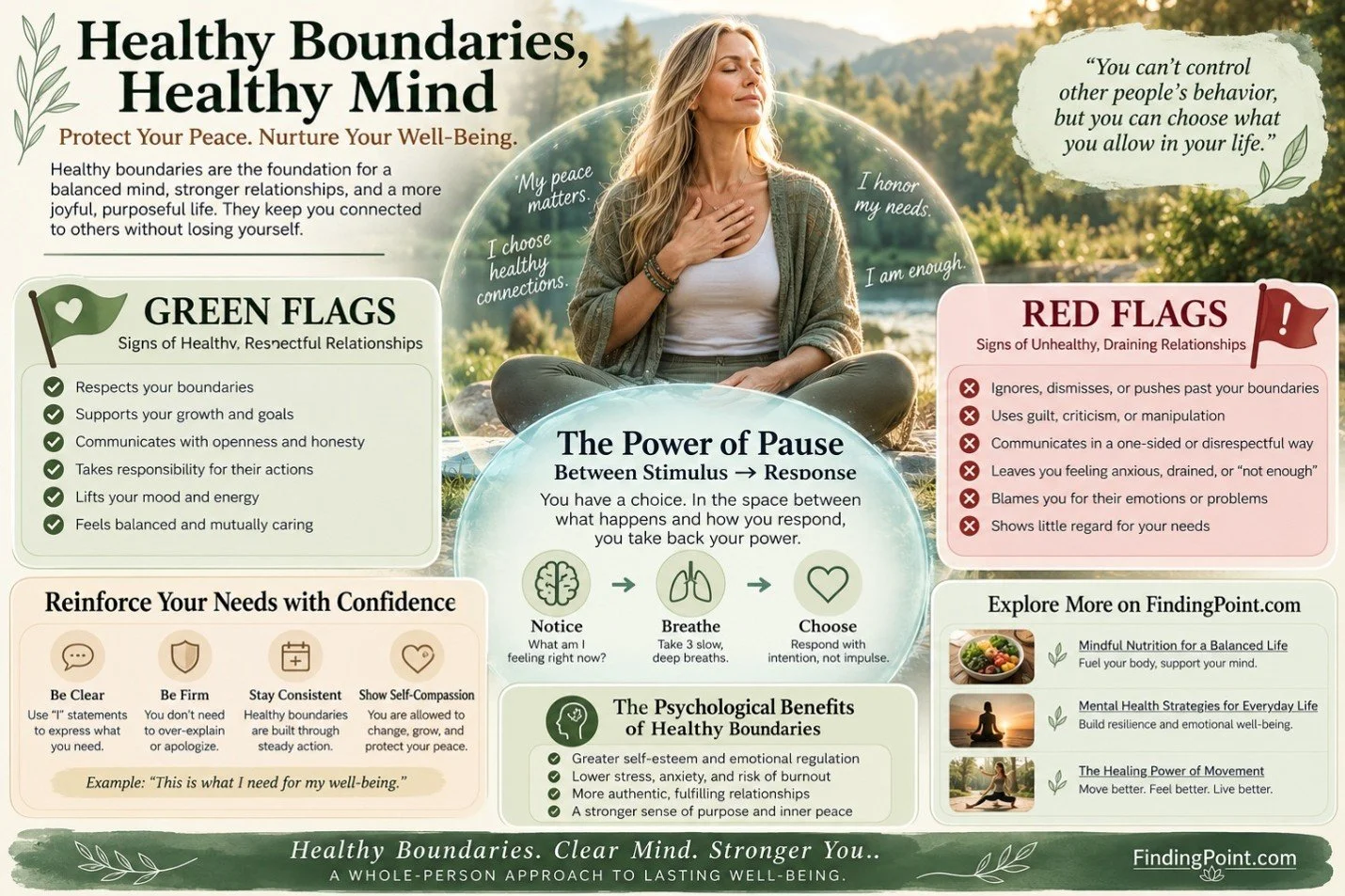
One of the most powerful boundary skills is learning to pause between stimulus and response. The stimulus is what happens: someone criticizes you, pressures you, interrupts you, blames you, or sends a message that triggers anxiety. The response is what you do next: argue, defend, apologize, freeze, comply, leave, breathe, or speak clearly. The pause is the space where your healthy mind has a chance to come online.
In stressful moments, the nervous system may move quickly into fight, flight, freeze, or appease. This is why you might say yes before you mean it, defend yourself before you understand the situation, or shut down even though you have something important to say. The pause does not mean suppressing your reaction. It means noticing your reaction before letting it drive the car.
Try a simple three-part pause: name, breathe, choose. First, name what is happening internally: “I feel pressured,” “I feel criticized,” or “I feel the urge to overexplain.” Second, breathe slowly enough to signal safety to your body. Third, choose a response that aligns with your values rather than your panic. This may sound like, “I need a moment before I answer,” “I’m not available for this conversation while I’m being spoken to that way,” or “I’ll think about it and get back to you.”
The pause protects your mental health because it shifts you from reaction to response. It reminds your mind that urgency is not always truth. Someone else’s pressure does not have to become your emergency. Someone else’s disappointment does not automatically mean you did something wrong.
How to Reinforce Your Needs When Pressed
Many people can state a boundary once. The harder part is reinforcing it when the other person pushes back. This is where psychological steadiness matters. If you have been conditioned to people-please, pushback can feel like danger. You may interpret another person’s frustration as proof that your boundary is wrong. In reality, pushback often means the boundary is doing its job: it is changing a pattern that benefited someone else at your expense.
Use short, steady statements. The goal is not to win a debate; it is to remain anchored in your need. Overexplaining can accidentally invite negotiation. A healthy boundary is usually clear, kind, and firm.
Boundary Scripts You Can Use
· “I understand you’re disappointed, and my answer is still no.”
· “I’m not discussing this while the conversation is disrespectful.”
· “I need time to think before I commit.”
· “That does not work for me.”
· “I care about you, but I cannot be your only support system.”
· “I’m willing to talk when we can both stay calm.”
· “I won’t explain this further right now. I’ve already shared my decision.”
Reinforcing your needs also requires internal self-talk. After setting a boundary, your mind may produce guilt: “Maybe I was too harsh,” “What if they leave?” or “I should have just handled it.” Respond to that guilt with grounded truth: “My needs are allowed to exist,” “Discomfort does not mean danger,” and “I can be kind without abandoning myself.” This is how you train the mind to tolerate relational discomfort without collapsing into self-betrayal.
Maintaining Boundaries Over Time
Boundaries are not one-time announcements; they are ongoing practices. Maintaining them requires consistency, self-awareness, and a willingness to tolerate temporary discomfort for long-term peace. If you set a boundary but repeatedly abandon it when someone pressures you, your nervous system learns that pressure works. If you reinforce it calmly and consistently, your mind learns that you can survive conflict without losing yourself.
Start by identifying your non-negotiables. These may include being spoken to respectfully, having private time, not responding to messages immediately, not lending money, limiting exposure to gossip, or refusing conversations that become emotionally abusive. Then decide the action that follows if the boundary is ignored. A boundary without an action step becomes a request. For example: “If the conversation turns into yelling, I will leave the room.” The action is what protects your peace.
It is also helpful to build supportive routines that strengthen your mental baseline: sleep, nourishing food, movement, journaling, therapy or coaching, mindful breathing, prayer or meditation, and time with people who feel emotionally safe. A regulated life makes boundary-setting easier because you are not trying to make hard decisions from a depleted mind.
Further Reading
For readers who want to keep exploring healthy mindset, nervous system care, and whole-person wellness, visit the Finding Point Journal. You can also read about Polyvagal Theory to better understand how stress and safety affect the body and mind.
Additional resources on boundary-setting and relationship health include this article from Help Guide and Positive Psychology's guide to healthful boundaries and positive relationships. These resources can complement the psychological tools discussed here and offer practical language for communicating limits with clarity.
Conclusion: Protecting Your Peace Is a Mental Health Practice
Creating and maintaining boundaries with negative people is not about becoming hard, selfish, or uncaring. It is about becoming honest. It is about telling the truth about your limits before resentment, anxiety, or exhaustion tell it for you. A healthy mind needs relationships that allow room for rest, self-expression, accountability, and mutual respect. When relationships repeatedly pull you away from those needs, boundaries help you return to yourself.
The more you practice pausing, filtering for green and red flags, and reinforcing your needs, the more your mind learns that peace is not passive. Peace is something you participate in. It is something you protect through choices, language, timing, and self-respect. You do not have to absorb every mood, answer every demand, or prove your worth to people who benefit from your silence. You can be compassionate and boundaried. You can be loving and clear. You can keep a healthy mind by choosing relationships—and responses—that support the life you are trying to build.
