When We Don't Want to Lose Ourselves
Learning to Stay Connected to Ourselves While Life Is Still Unfolding
There was a question I found myself asking recently that caught me by surprise. Not because it was a new question. If I'm honest, I think I've probably asked it in different ways throughout my life. This time, though, it landed differently. Instead of feeling like a passing thought, it settled somewhere much deeper.
How do I not lose myself while this unfolds?
At first, I thought I was asking about someone else. I wanted to understand their choices, their timing, and the direction their life seemed to be taking. My mind did what it has always done whenever something matters deeply to me. It became curious. I replayed conversations, thought about little moments that probably meant very little, and wondered whether I had missed something that would suddenly make everything make sense.
The longer I sat with that question, however, the more I realized I wasn't really asking about them at all. I was asking about myself. More specifically, I was asking how we continue caring deeply about someone or something without quietly allowing it to become the center of our emotional world.
I have a feeling many of us eventually ask some version of that question. Sometimes it's because we're waiting for someone we love to decide what they want. Sometimes it's because we're hoping a difficult season will finally come to an end. Sometimes we're waiting for test results, grieving the loss of a relationship, watching a child struggle, or standing at the edge of a new chapter that feels both exciting and terrifying.
The circumstances are different, but the experience often feels the same. Life hasn't stopped. It simply hasn't finished unfolding. And somewhere in the middle of all that uncertainty, we begin wondering how to keep living our own lives while our hearts are still waiting for answers.
I don't think we talk about this space very often. We hear a lot about letting go, moving on, or choosing ourselves. Those ideas certainly have their place, but they can also make it sound as though every difficult season has a clear turning point. As though one day we simply decide to stop caring, tie everything up with a neat little bow, and move on with our lives.
At least for me, that hasn't been how healing has worked. Most of the meaningful growth in my life has happened while nothing felt settled. It happened while I was still carrying unanswered questions, while I still cared deeply, and while I was trying to figure out how to remain fully present in my own life instead of quietly revolving around circumstances I couldn't control.
The more I reflected on that, the more I realized this wasn't really a relationship lesson. It was an attention lesson.
Curiosity Has Been One of My Greatest Teachers
If there is one quality that has shaped my life more than almost anything else, I think it would be curiosity. I've always wanted to understand people. Why do we respond the way we do? Why do some experiences leave lasting marks while others seem to fade? Why can two people experience the same event and walk away carrying completely different stories about what happened?
Sometimes I think curiosity has been my greatest strength. Other times, I think it's exhausted me. The truth is, curiosity has helped me become a more compassionate person. The older I get, the less interested I am in deciding whether someone is "good" or "bad." Life has taught me that people are usually far more complicated than that. We all carry histories that shape how we see the world, and most of us are doing the best we can with what we know in that moment.
That perspective has made it easier for me to extend grace to other people. What I've had to learn, however, is how to extend that same grace to myself, because curiosity has a shadow side. When there aren't enough answers, curiosity can quietly become rumination. Instead of helping us understand, it keeps us circling the same questions.
Have you ever noticed yourself replaying the same conversation while you're driving somewhere? Or lying awake at night thinking, Maybe they meant this... or I wonder if I should have said that differently...
I certainly have. What's interesting is that our minds aren't doing this because they're trying to make us miserable. They're trying to make us feel safe.
Psychologists have long understood that our brains are prediction machines. They are constantly scanning for patterns because predicting what happens next helps us navigate the world. When life suddenly becomes uncertain, our minds naturally work harder to fill in the blanks. We create explanations, imagine possibilities, and search for clues because uncertainty feels uncomfortable. The problem isn't that our minds do this. The problem is that we often begin believing every story they create.
I've had to remind myself that there is a difference between wondering and knowing. That sounds obvious when I say it out loud, but it's much harder to remember when emotions are involved.
One practice that has helped me is asking a simple question whenever I notice myself becoming caught in the stories my mind is creating.
What do I actually know?
Not what I fear. Not what I hope. Not what I've imagined. What do I actually know? It's surprising how often that question brings me back to solid ground.
The American Psychological Association explains that becoming more aware of our thoughts is one of the first steps toward responding intentionally instead of reacting automatically. We don't have to believe every thought simply because it crosses our minds. Learning to notice our thinking patterns can help us make choices that are more aligned with the life we want to live rather than the fears we're trying to escape.
I've found that incredibly freeing, not because it gives me answers, but because it reminds me that uncertainty doesn't require me to invent them.
When Someone Else's Story Becomes Bigger Than Our Own
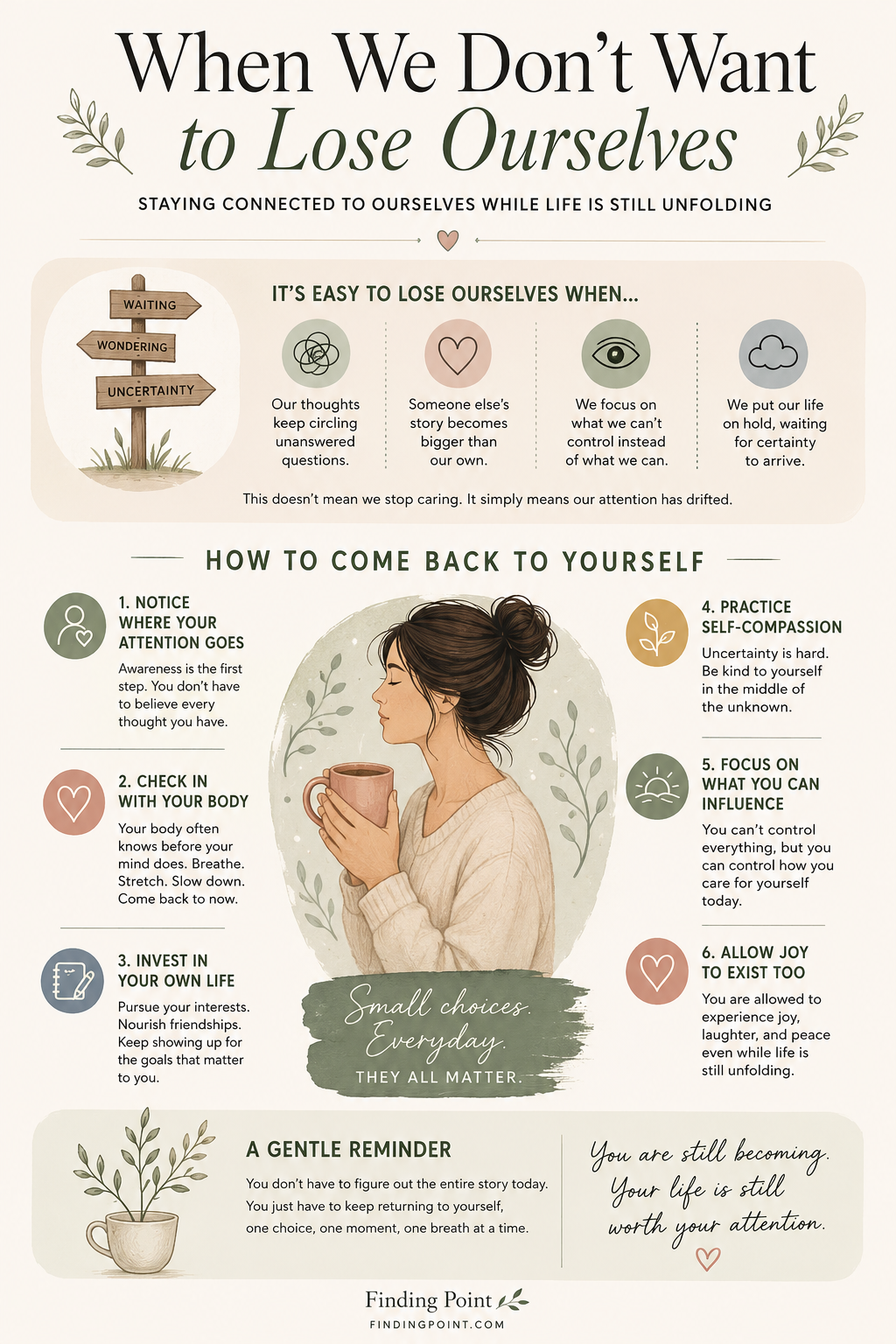
This has probably been the hardest lesson for me to admit. Not because it's embarrassing, but because it's so easy to do without realizing it. There have been seasons where I slowly noticed that someone else's life had become more interesting to me than my own.
I wasn't neglecting my responsibilities. I was still showing up for work. I was still taking care of the things that needed to be done. From the outside, nothing looked particularly different. Internally, though, my attention had drifted.
I found myself wondering what they were thinking, what they might do next, whether circumstances would change, and what the future might hold. None of those questions were wrong. They simply began taking up more space than the questions I should have been asking about my own life.
Looking back, I don't think I was losing myself all at once. I think I was losing myself a little bit at a time. A little less attention on my own dreams. A little less energy invested in my own purpose. A little more emotional space given to things I couldn't control.
That's how it happens for many of us. Not dramatically. Quietly. Almost gently. Until one day we realize we've been watching someone else's life unfold while our own has been patiently waiting for us to come back to it.
And that realization isn't meant to fill us with guilt. It's meant to invite us home.
Coming Home to Ourselves
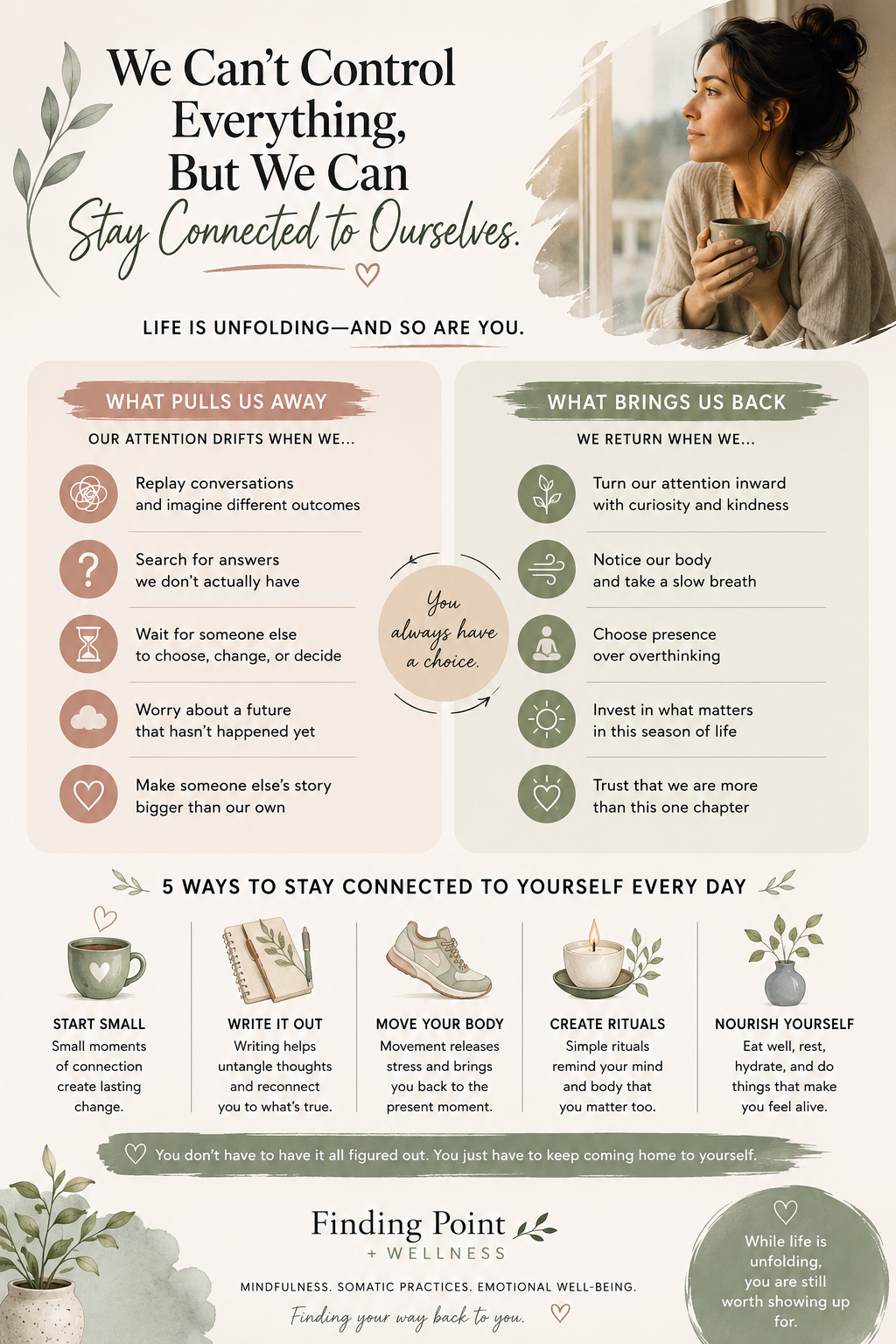
I used to think that coming home to myself meant reaching a place where I no longer cared so deeply. If I could just stop thinking about the situation, stop wondering what someone else was going to do, or stop feeling disappointed, then maybe I would finally feel at peace.
I've come to believe something different. I don't think peace comes from caring less. I think it comes from remembering that our lives deserve our attention too.
That realization changed the question I was asking.
Instead of wondering, What are they going to choose? I slowly began asking, What do I need today in order to stay connected to myself?
At first, that felt almost selfish. Somewhere along the way, many of us learn that paying attention to ourselves means we're ignoring everyone else. Yet I've noticed the opposite is usually true. The more grounded I am in my own life, the more present I become in my relationships. I'm more patient, more compassionate, and less likely to expect another person to carry responsibilities that belong to me.
I've also realized that coming home to ourselves rarely happens through one life-changing decision. More often, it happens through a hundred quiet choices that don't seem very important at the time.
It's choosing to go for a walk instead of spending another hour replaying the same conversation. It's making plans with a friend instead of waiting to see whether someone else reaches out. It's working toward a goal that matters to us, even while part of our heart wishes another situation would resolve itself. It's remembering that we are still allowed to laugh, create, learn, rest, and experience joy while life is unfinished.
None of those choices erase uncertainty. They simply remind us that uncertainty isn't the only thing happening in our lives.
Building a Life Instead of Waiting for One
This may be the lesson I'm still learning. For a while, I didn't realize how much of my emotional energy had become invested in possibilities. Maybe things would change. Maybe the timing would become different. Maybe life would unfold in a way I couldn't yet see.
Hope isn't the problem. I never want to become someone who stops hoping. Hope has carried me through seasons I wasn't sure I could survive. It has reminded me that difficult chapters are rarely the whole story. Without hope, many of us would stop trying long before healing ever had a chance to begin.
What I've been learning, though, is that hope works best when it walks beside reality instead of running ahead of it.
When my emotional well-being becomes dependent on a future I can't control, I quietly stop participating in the life that's happening today. My mind begins living somewhere else. Instead of noticing the opportunities, relationships, and purpose that still exist in front of me, I find myself waiting for one particular outcome to determine whether I can finally feel at peace.
I've done that before. Maybe you have too. The difficult part is that we usually don't notice it's happening until we've already drifted away from ourselves. This is yet another reason it is useful to have boundaries with ourselves and how far we will let ourselves drift before we self-check for our own wellbeing.
One question has helped me more than almost any other.
If nothing changed tomorrow, what kind of life would I want to be building today?
I don't ask myself that question because I've given up hope. I ask it because I don't want my future to depend entirely on circumstances I cannot control. That question gently returns me to the only life I can actually live: my own.
Our Bodies Often Know Before Our Minds Do
One of the things I've appreciated most about learning more about emotional health is realizing that our thoughts don't exist separately from our bodies.
When I've been living with uncertainty for a while, I usually notice it physically before I fully recognize it emotionally. My shoulders become tense. My breathing becomes shallow. Sleep doesn't come as easily. I feel distracted even when I'm trying to focus on something I enjoy. Sometimes that has also meant recognizing and curbing self-destructive habits that I notice are becoming increasingly present.
For years, I assumed I simply needed to think differently. Now I understand that sometimes my body needs care just as much as my thoughts do.
That's one of the reasons I've grown to appreciate somatic practices. They aren't about forcing ourselves to relax or pretending everything is fine. They're gentle reminders that our nervous systems respond to uncertainty just as naturally as our minds do.
Sometimes the most healing thing we can do is slow down long enough to notice how we're holding stress. Take a slow breath. Go for a walk. Stretch for a few minutes. Step outside and feel the warmth of the sun or the coolness of the evening air.
These aren't magical solutions. They won't answer the questions we're carrying. But they can help remind our bodies that this moment is safe, even while the future remains uncertain. The can offer stillness, if only for a few moments.
Paying Attention to Where Our Attention Goes
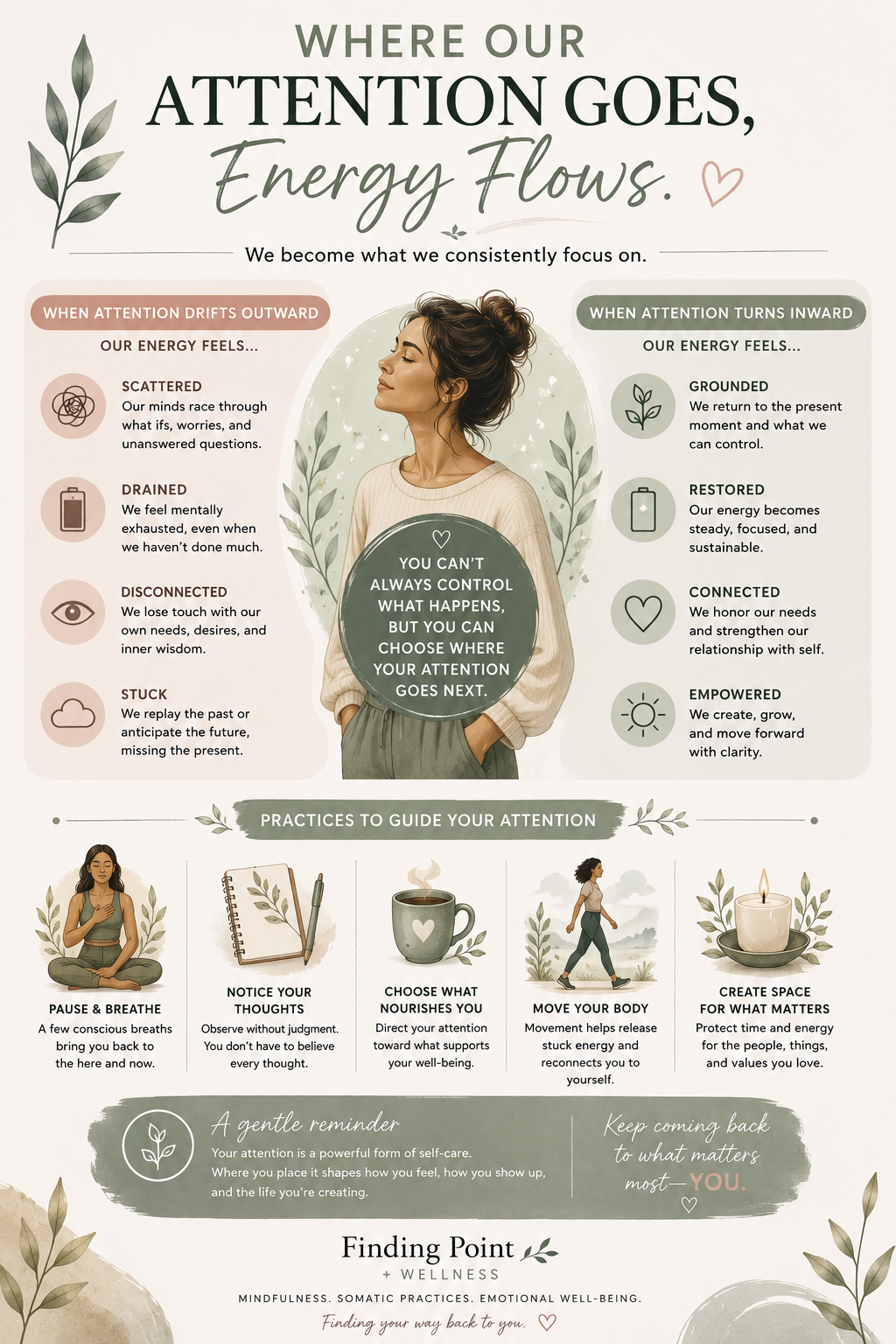
An idea I've continued coming back to while writing this article, it's this: Attention shapes experience. Whatever consistently receives our attention slowly begins shaping the way we experience our lives.
If all of my attention is focused on questions I can't answer, I begin feeling as though my entire life is made up of uncertainty.
If all of my attention is focused on another person's choices, I gradually lose sight of my own.
The interesting thing is that attention isn't something we control once. It's something we gently guide over and over again. There are still days when I notice my thoughts wandering back toward questions that don't have answers. When that happens, I try not to criticize myself. Instead, I simply notice.
Then I ask myself another question.
What would it look like to give this same attention to my own life?
Sometimes that means sitting down to write. Sometimes it means reading a book. Sometimes it means calling someone I love. Sometimes it means spending time in nature or making a meal that actually nourishes me instead of eating whatever is quickest because my mind has been somewhere else all day.
These moments may seem ordinary, but I don't think they are. I think they're how we quietly return to ourselves.
We Don't Have to Figure Out the Entire Story Today
I sometimes wonder if one of the greatest gifts we can give ourselves is permission to stop rushing toward certainty. Not because certainty isn't valuable, but because life doesn't always offer it.
There are questions I still can't answer. There are situations that still make me sad. There are people I still care about deeply. None of that means I'm doing something wrong. It simply means I'm human.
The Greater Good Science Center has published extensive research on self-compassion, showing that people who respond to themselves with kindness during difficult experiences often become more emotionally resilient over time. That doesn't mean pretending everything is okay. It means recognizing that suffering is part of being human and responding to ourselves with the same understanding we would naturally offer a friend.
I love that perspective because it removes the pressure to heal perfectly. Maybe healing isn't about reaching a place where uncertainty no longer hurts. Maybe it's about learning that uncertainty doesn't have to prevent us from living.
An Invitation
If you've found yourself waiting lately, I hope you'll be gentle with yourself. Maybe you're waiting for a relationship to become clearer. Maybe you're hoping someone you love finds healing. Maybe you're standing in the middle of a life transition that feels uncertain. Or maybe your story looks nothing like mine, yet the question still feels familiar.
How do I not lose myself while this unfolds?
I don't think there is one perfect answer. At least, I haven't found one. What I have found is something quieter: every day gives us another opportunity to return to ourselves.
Not because we've stopped caring. Not because every question has been answered. But because our lives are still happening too.
I've realized that I don't want to spend this season watching someone else's story unfold while forgetting to live my own.
I want to keep building a life that reflects my values, investing in relationships that are present today, caring for my emotional and physical well-being, and continuing to grow into the person I'm becoming.
If the future brings unexpected joy, I'll welcome it. If it brings disappointment, I'll meet that too. Either way, I hope I remember this: life is unfolding around me, but it's also unfolding within me. And I don't want to miss either one.
