Emotional Self-Regulation
"Emotions alter the street we walk upon, paving the landscape of our life"
- Stephanie @ Finding Point
Emotions and Self-Regulation
We've all been in a place where our emotions may seem bigger than they are. Events that stir inner wounds may also sometimes bring us back to places that we thought were healed. Although there is no quick fix when it comes to regulating our emotions, we do hold the power to, over time, transform overwhelming feelings into manageable experiences that help us to grow rather than elicit negative memories and patterns.
A quick definition of emotional regulation is the ability to control one’s own emotional state. This may include challenging your thoughts and using healthy strategies to alter negative emotions. Although every person has their own way of processing, a goal is to be able to work with our emotions in a way that we can more clearly recognize and identify them without overwhelm. This does not mean disassociation, only a healthy detachment.
In my upcoming book, “Mindful Self: An Easy Guide Around Cognitive Distortions”, I offer additional tools that can help in recognizing emotional triggers and thinking your way through them more healthfully.
An Emotional Regulation Technique
There are many techniques that help us to see our emotions in ways that make them easier to work with and process though. This method utilizes a more holistic approach with a recognition of future somatic implications.
Practice (ERT1)
The exercise is done with both positive and negative emotions since a goal is to regulate and not overly attach to any feeling. A general idea is to look at 3 or 4 different emotions each sitting. Although the emotions can repeat as desired in different sessions, it is helpful to play with a wide range of emotions. The chart below may help offer an easy-start for exploring your emotions.
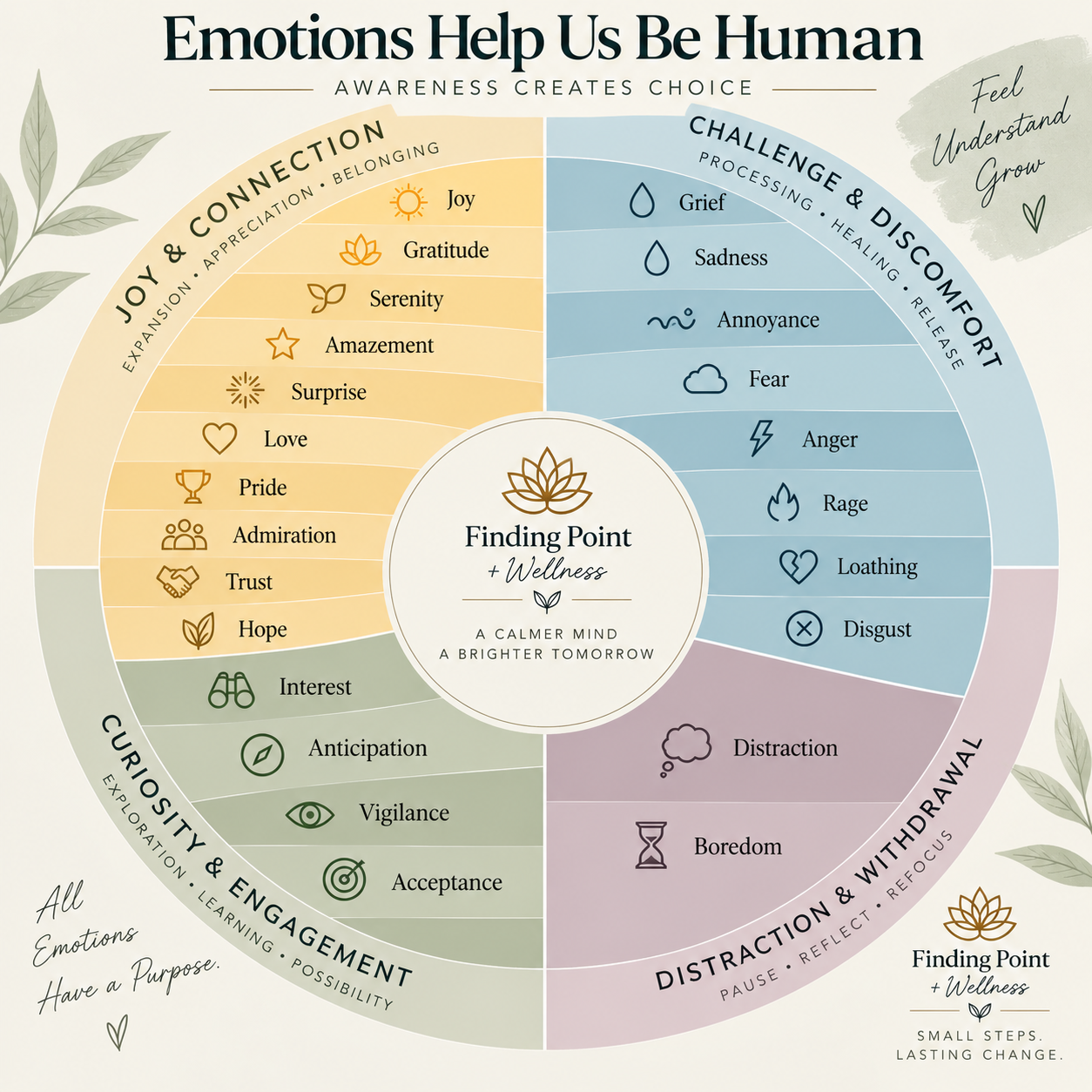
Note: Choose 3-4 Emotions per Session. It's ideal to end on a peaceful emotion.
Practice Session: Descriptive Observance, Healthful Emotional Detachment Practice 1
· The practice begins with you sitting comfortably in a private, quiet space.
· You can close your eyes or leave them open, whatever works best.
· If you keep your eyes open, a soft unfocused gaze can be helpful.
· Allow yourself to breathe naturally.
· Choose a single emotion at a time.
· Visualize the emotion, perhaps place it a few feet in front of your chest area.
· Next, observe and describe it without any feeling or attachment.
· Take your time here… What color is it? Are there several colors? Is there a shape to it? Does the shape change? Is it smoky, maybe solid? Both? Is it vibrating? Does it seem stagnant? Use whatever descriptive words work for you.
· If any additional feelings/thoughts come out, recognize they are there, but pay them no mind.
(The goal is to see the emotion, respect it in its entirety, but not internalize it. You're only an observer. You are you, this is an emotion that you are feeling, but the emotion itself is not you, only a guide).
· After a couple of minutes of "examining the emotion", bring it back in.
· Perhaps reach out to it and pull it towards your heart center with compassion.
· Hold the emotion as lovingly as possible in your heart center, allowing yourself grace for the experience.
· Neither good nor bad, accept it as just a part of you.
Repeat this process with each of the 3 or 4 emotions, ending with an emotion that leaves you calm.
Note: If the practice is overwhelming, a modification is to begin with only pleasant emotions until you become more comfortable. Another idea is to try only 1 or 2 emotions per session.
How often should I Practice?
When I worked this exercise, I did the practice at least daily, but often many times a day as I became more used to “seeing” without “feeling”. These type exercises show increasingly positive results when done with consistency. Emotional regulation exercises can also be a great way to re-center during the day where you may otherwise have become caught up.
Personal Note
A turning point for me was when I stopped trying to push away my emotions. Where I had previously been hateful towards my painful ruminations, I recognized they needed to proactively be seen for what they were: unprocessed experiences and lingering emotional resonance. Looking at my feelings without the hate and shame, but with love and grace allowed me to better separate and heal. This also lessened a self-created cycle that I had been feeding for a long time.
Closing
Emotions are normal and natural. Sometimes our feelings may get away with us, but we hold the power to lessen this cycle through applied knowledge and self-understanding. With practice, we can become observers of what we are feeling so that it becomes simpler to see emotions for what they are versus getting caught up. There are many techniques that can help us find better inner balance. We can also learn to be mindful of what our feelings are communicating to us and create inner change that generates a healthier future.
With love, Stephanie
03/07/2023
